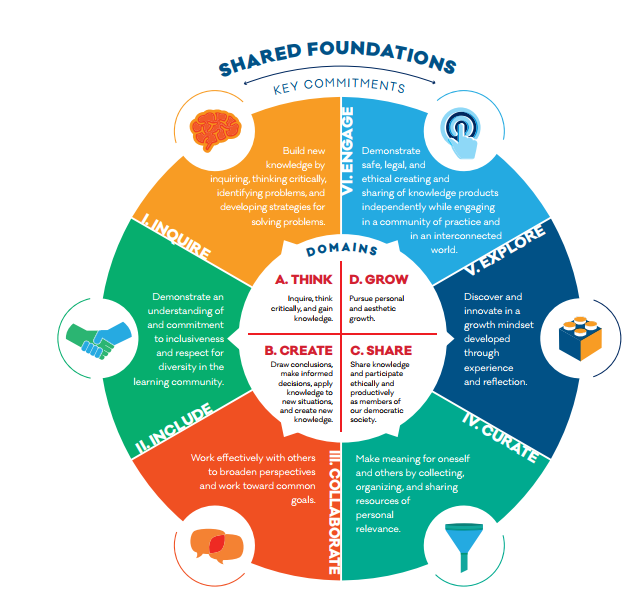
Links to the learning standards for the information and technology skills taught during all Library or LibTech classes are available here. The national standards are from the American Association of School Librarians and the National Educational Technology Standards.
American Association of School Librarians
National Educational Technology Standards

Click here for a quick glance at the concepts we will cover during library class time this school year.
This is the Essential Learning Curriculum adopted by the Catholic School Librarians’ Group in the Archdiocese of Seattle. This document in conjunction with the American Association of School Librarians Standards for the 21st Century Learner guide the information, research, and reading skills taught at Holy Rosary School.
ESSENTIAL LEARNING CURRICULUM
| Essential Learning #1 |
| Students will construct strategies for locating information |
| To meet this standard, the student will… |
| recognize that the library is a place to find information |
| recognize that the catalog is an index to all materials in the library |
| learn search strategies for subject, series, authors, titles |
| learn electronic search strategies for keywork (include Boolean) |
| understand the parts of a library record |
| understand the function and use of the call number (NF +F and how it relates to physical location in the library |
| recognize that different reference sources will answer different typs of questions (almanac, encylopedieas, etc.) |
| learn ONLINE search stategies |
understand concept of a database
| Essential Learning #2 |
| Students will locate and access information |
| to meet this standard the students will… |
| locate materials from MARC records in library databases |
| Learn parts of title page: author, titles, publisher and place of publication |
| learn part found on versa: copyright (importance of) |
| understand uses for dictionary, thesaurus, atlas, almanac, encylopedias |
| locate materials by call number: special places: Fiction, biography, Dewey (recognize main sections of the library: F/E/NF |
| know the purpose of the spine label; understand the symbols; understand the alpha concept of last names first; Dewey Numbers relate to non-fiction |
| use the best reference source for information purposes |
| make effective choices of electronic resources for research |
| use relevant websites for age appropriateness/grade level |
| use different search engines for purpose of searching |
| use key words for effective searching |
| use premium databases (Proquest, elibrary) |
| understand the part of the book: dedication, table of contents, bibliography, glossary, index |
| scan and skim for major ideas |
| understands uses for biographical and geographical dictionaries |
| interpret graphic sources for information: charts, schedules, diagrams, globe, surveys, maps, telephone directories |
| understand and use boolean searching techniques |
understand alphabetizing concept: shelving, indexes, etc.
| Essential Learning #3 |
| Students will evaluate and extract information |
| To meet this standard, the student will… |
| identify and select specialized reference materials |
| understand bibliography , cite author’s sources |
| understand dated vs current information |
| identify authors’ bias in print and electronic sources |
| distinquish between opinion and fact |
| understand concept of ease of publishing on internet vs book |
| evaluate web sites according to access, design and content |
learn ethical use of information and technology
| Essential Learning # 4 |
| Students will responsibly select resources for personal reading and growth |
| To meet this standard, the student will… |
| recognize the Caldecott Award |
| recognize the Newbery Award |
| select materials based upon the synopsis of the book/jacket |
| select books based upon |
| favorite authors |
| popular series |
| subject matter |
| recognize fiction |
| recognize non-fiction |
| recognize genres |
| recognize books at appropriate levels/interest |
| analyze non-fiction materials for current relevancy versus outdated information
Link to the AASL Standards for the 21st Century Learner |
|
|
|